
The Proof Is in the Data: What 3,600 Patient Questionnaires Reveal About Youth Sports Injuries
At University Orthopaedic Associates (UOA), clinical excellence and data-driven care go hand in hand. To better understand the underlying factors contributing to youth athletic injuries, Eric Nussbaum, a retired athletic trainer at UOA, conducted an in-depth research review analyzing our supplemental sports questionnaire (SSQ), completed by athletes under the age of 24 who come to UOA for care.
UOA developed the SSQ several years ago to help identify factors that contribute to sports injuries. The SSQ helps us treat not just a specific injury, but the whole athlete. This questionnaire incorporates questions on diet, sleep, weight training, specialization, stress/anxiety and sporting involvement, which can affect injury and its recovery. We gathered and analyzed a dataset of responses from more than 3,600 patients to uncover key trends regarding how athletic demands, growth cycles and lifestyle factors intersect to create distinct injury windows.
Analyzing the Adolescent Athletic Journey
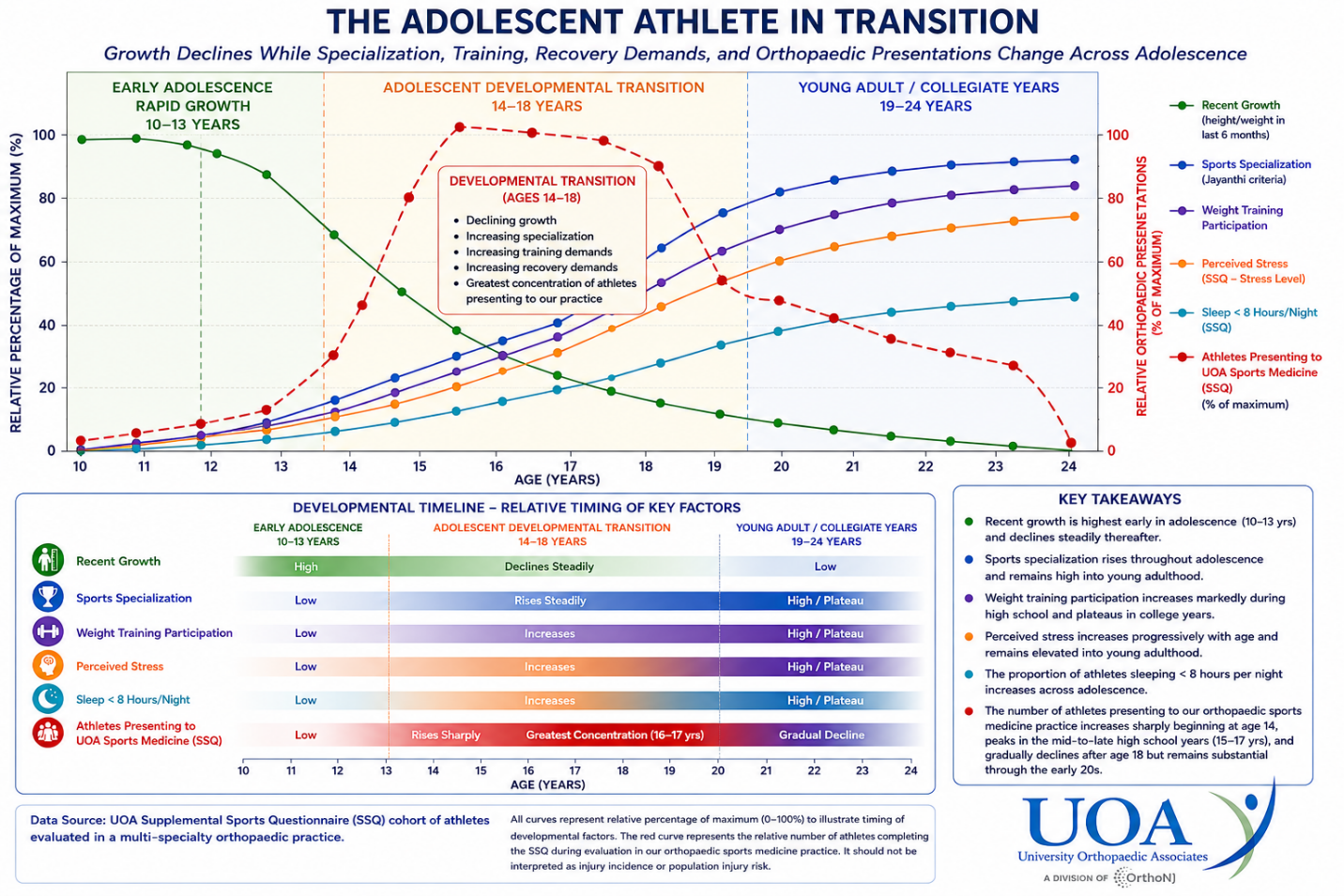
When we grouped patient responses by age, his research revealed a significant spike in visits among athletes aged 14 to 18. Layering these data points alongside training habits, sleep profiles and physical maturation paints a clear picture of how injury risks evolve across three distinct developmental stages:
- Early Adolescence (Ages 12–14): Middle school and early high school represent a period of rapid longitudinal bone growth, muscle lengthening and developing coordination. Overall, this age group exhibits lower sports specialization, consistent sleep profiles and manageable practice schedules, making it a relatively low-risk window for overuse injuries. However, developing bones combined with increasing activity levels do create a distinct window for acute fractures and growth plate injuries.
- The Transition Stage (Ages 14–18): High school marks a critical transition. As athletes undergo rapid physical maturation, sports demands increase through year-round specialization, intense competition and regular weight training. When sporting demands are coupled with increasing social commitments, we notice a change in sleeping habits. Increased sporting and training demands highlight the importance of proper nutritional and caloric intake. This overlap of physical growth and escalating physical demand creates a peak injury window, spiking around ages 15 and 16.
- Maturation & High Demand (Ages 18–23): As athletes reach physical maturity, longitudinal growth stabilizes while muscle mass increases. While some transition to recreational sports, collegiate athletes face peak training hours, advanced strength conditioning and high-impact competition. Although this population accounts for a smaller total volume of clinic visits, their injuries are often significant, resulting from higher speeds and advanced levels of play.
The Vital Role of Athletic Trainers
Our data-driven insights reinforce what our clinical team observes daily: athletic demands and life transitions are heavily shaped by growth and maturation. Licensed athletic trainers play a key role in helping athletes and parents navigate the challenges of sports and physical development and are indispensable to an athlete’s long-term health.
Whether operating in secondary schools, colleges, or clinical settings, athletic trainers sit on the front lines of injury management, acute care, and long-term athletic development. Working closely with sports medicine physicians, ATs provide immediate evaluation, employ therapeutic modalities to manage pain and inflammation, and design comprehensive rehabilitation exercises. From managing the initial injury through guiding sport-specific progressions, athletic trainers safely navigate student-athletes through every stage of recovery and return to play.
At UOA, our sports medicine specialists, physiatrists, orthopaedic surgeons and dedicated athletic trainers remain committed to collecting advanced data in order to provide evidence-based care to keep young and maturing athletes safe, strong and competing at their highest potential.
To learn more about our comprehensive sports medicine services, explore our Sports Medicine & Arthroscopic Surgery capabilities.